
First, check that you're in the City
A Santa Cruz mailing address doesn't always mean the City's rules apply. Neighborhoods such as Live Oak and Pleasure Point are in the unincorporated County, which has its own ADU rules. If you're not sure, the City's planning counter answers at (831) 420-5416.
How many units you can add
On a lot with a single-family home, the City allows:
- one detached new ADU of up to 800 square feet that meets the state's short list of standards (the City calls this a "Statewide Exemption" ADU),
- one conversion ADU inside an existing building, such as a garage,
- one more ADU built to the City's own standards, and
- one junior ADU inside the house, if the owner lives on the property.
Lots with apartments or condominiums get more: up to eight detached ADUs, never more than the number of existing units, plus conversions of unused space such as storage rooms or garages.
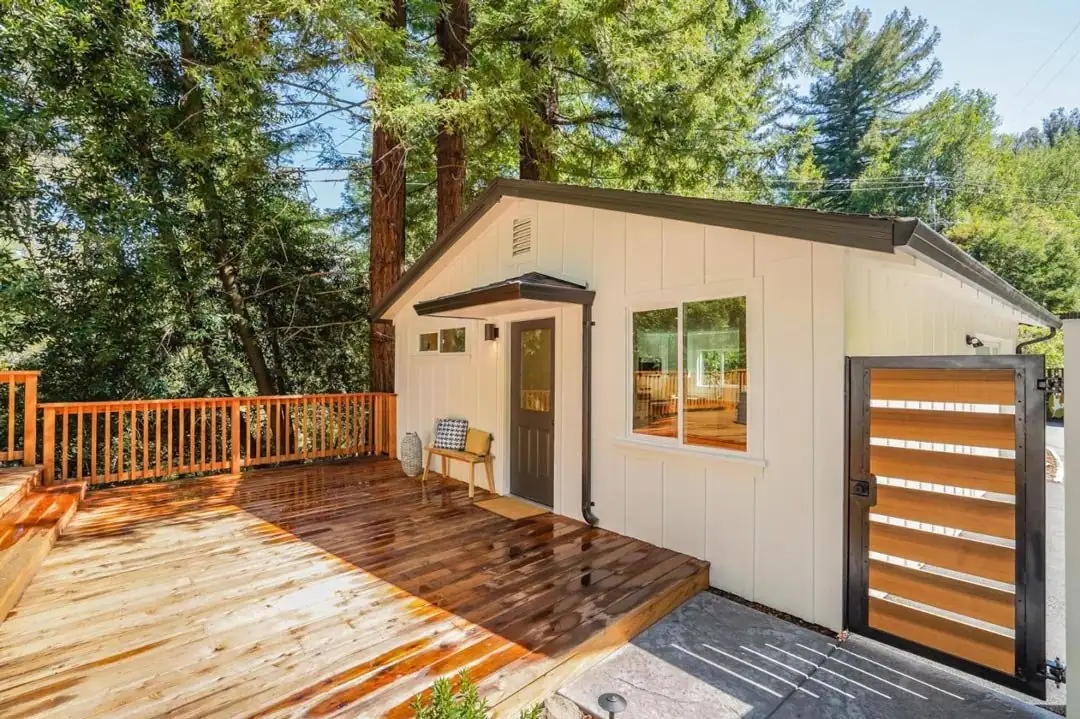
The 800 square foot cottage
State law protects this unit. The City can hold it to only a short list of standards:
- no more than 800 square feet,
- at least 4 feet from the side and rear property lines,
- up to 16 feet tall, or 18 feet within half a mile walking distance of a major transit stop or high-quality transit corridor (20 feet there if the roof pitch matches the house),
- one story.
Bigger detached units
If you want more room, a detached ADU built to the City's own standards can be the larger of 10 percent of the lot's net area, up to 1,200 square feet, or 850 square feet for a studio or one-bedroom and 1,000 square feet for more than one bedroom. It can be up to 22 feet tall.
- It must sit at least 3 feet from the side and rear lines, and any part above 16 feet at least 4 feet.
- It must be at least 6 feet from any other building on the lot.
- Where it is closer than the zone's normal setbacks, its entrance, stairs and upstairs decks face into the lot, and windows facing a neighbor must be obscured or screened.
Attached units and conversions
- Attached ADU. An addition to the house can be the larger of half the home's living area, or 850 square feet for a studio or one-bedroom and 1,000 for more. It follows the height and front setbacks of the house, but needs only 4 foot side and rear setbacks.
- Conversion ADU. A legal garage, workshop or guest house can become an ADU of any size. You can add up to 150 square feet of footprint and 2 feet of height. The converted building has to meet today's building code for a home.
Not sure which of these fits your lot? The quiz asks about your lot and what the unit is for.
Take the quizJunior ADUs
A junior ADU is up to 500 square feet inside the house, with its own outside entrance and a food preparation area. It can share a bathroom with the house through an inside door. The owner has to live in the house or the junior unit, a land use agreement is recorded, and the junior unit can't be sold separately.
Parking
Outside the Coastal Zone, an ADU needs no parking, and spaces removed to make room for one don't have to be replaced. Inside the Coastal Zone, the rules depend on where the lot is, so check with a planner.
Permits, hearings and the coast
- An ADU needs a building permit with drawings, energy and green building calculations, and inspections.
- There is no public hearing, no public notice, and a building permit can't be appealed.
- Some lots in the Coastal Zone also need a Coastal Permit.
- The City runs a pre-approved ADU plan program, set up under state law AB 1332, with a 30-day review and lower permit costs for detached ADUs.
Water, sewer and fire sprinklers
A new detached ADU will almost always need its own water and sewer connections. Conversions and attached units don't need separate ones, but can outgrow the existing water meter. The City can't require fire sprinklers in an ADU when the house doesn't have or need them. An attached ADU larger than half the home's living area can trigger sprinklers for the whole building, so check with City Fire first if you're close.
Renting it out, or selling it
- No owner occupancy is required for an ADU.
- A single-family property with an ADU can't be in the City's short-term rental program. The unit is meant for family, a household member or a long-term tenant.
- Since 2025, an ADU can be mapped as a condominium and sold separately. A junior ADU can't.
Questions homeowners ask
Do I need a public hearing to build an ADU in Santa Cruz?
No. Most ADUs in the City need only a building permit, which needs no public notice and can't be appealed. Some lots in the Coastal Zone also need a Coastal Permit.
Do I have to live on the property?
Not for an ADU. The owner does have to live on the property to add a junior ADU.
Can I rent my ADU on Airbnb?
Not on a single-family property. Single-family homes with an ADU aren't eligible for the City's short-term rental program.
Does an ADU need its own parking space?
Not outside the Coastal Zone, and parking you remove to build one doesn't have to be replaced. Inside the Coastal Zone it depends on the location.
The quickest way to know what your own lot allows: the 60-second quiz, then a free 20-minute call with Josh if you want one.
Take the quizSources
- Accessory Dwelling Units (ADUs): rules, standards and FAQs, City of Santa Cruz
- Santa Cruz Municipal Code, Chapter 24.16, Part 2 (ADU regulations)
- Building and Safety: pre-approved ADU program, City of Santa Cruz
- ADU Basic Requirements (Pleasure Point and Live Oak areas), County of Santa Cruz
Rules change. We checked every source on October 27, 2026. Call the City or County planning counter before you design.